Background
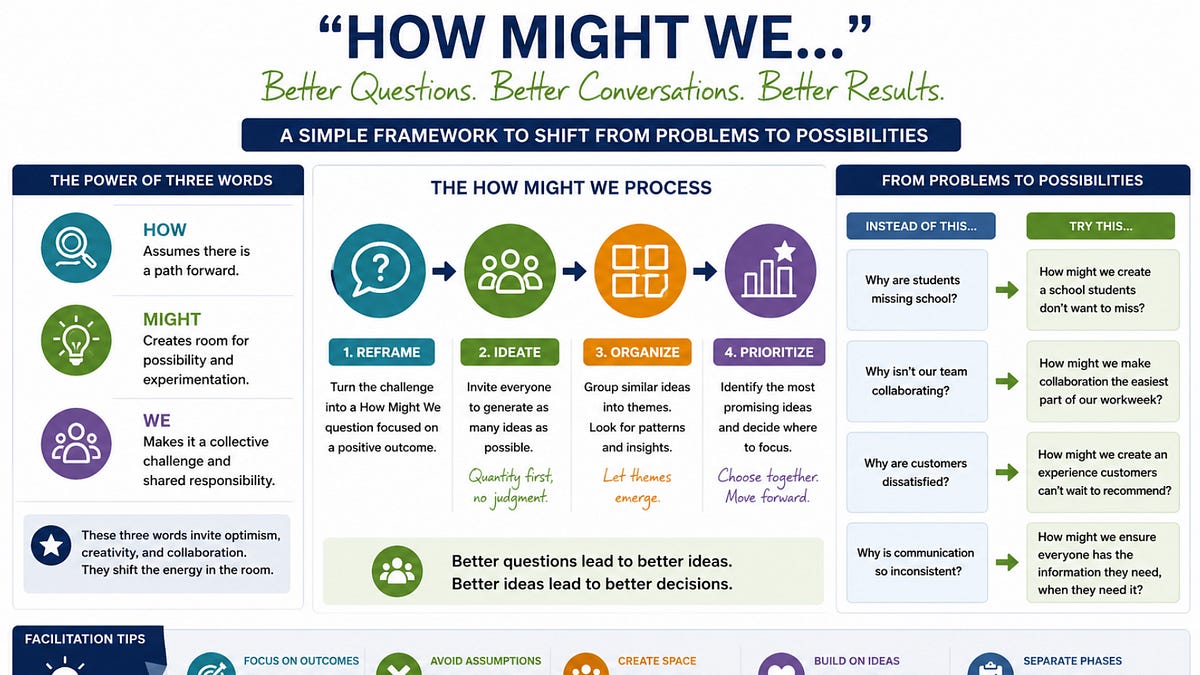
HMW (abbreviation for “How Might We”) is a popular way of reframing challenges that you may have collected during a workshop’s initial phase. They are often important initial values for further exercises and are meant to describe, or reframe, a problem or a challenge in a positive way.
How Might We
“Be able to increase signing up for our excellent coffee delivery service”, for instance. A closely related framing could be “Stop customers from unsubscribing from our excellent coffee delivery service”.
Both above examples could be re-framings of a challenge formulated in an earlier exercise, as for example from a sailboat exercise, where the output answers the question:
What’s holding us back?
“Sales are growing much slower than expected”. The problem people often get stuck on is to draw a conclusion from a problem and formulate a possibility from it, described in the challenge, and instead either gets a brain freeze, or they might jump over one step and go into describing a solution (of a not yet drilled down problem, since the problem formulation might need some adjustment onwards, or if that is to be skipped since it might lack value).
This is also a common behavior when for instance performing Lean games, with LEGO or other forms - when participants observe a bottleneck they describe it with a solution and the game leader must then “app-app-app, you are now describing a solution, too early for that, we must get to a common view on what the problem actually is first”, and this is often much harder than diving into solution mode.
So, when phrasing what’s holding you back, take the opportunity to just leave the problem formulation as it is. Focus should be on possibilities, without describing the solution.
Avoid getting stuck - suggested solution
It could be that the HMW phrasing work is viewed as too challenging and it gives participants performance anxiety, or it needs a unified description, more of a syntax.
We often try to mitigate the anxiety by running different sorts ofwarm-ups in order to get participants into a creative mode, as well as give other examples that other groups have written earlier. These examples can act as guidelines, but are maybe not always viewed as an obvious explanation about what the HMW should describe. This is highly dependent on what goes on inside the participants head at the time.
The foregoing work in order to be able to start imagine HMW’s is often a sailboat exercise and the HMW’s are most often connected to the “problem output” of the sailboat. Another thing to give as support before starting an HMW could be a list of examples of initial phrases, for instance:
How Might We
Be better at...
Avoid...
Increase...
Do less of...
Do more of...
Make the...
It is probably possible to make this list even longer, but this is what comes to my mind initially. What I believe is most useful is concrete examples that relate to the topic of the actual event.
Bill Clarke (link below in Reference section) has written a great piece about this which is based on the origins from IDEO, Stanford, Google etc. He points out that it isn’t the problem that is subject to be formulated, it is to reframe towards possibilities. But I would like to fill in that if you haven’t done anything regarding problem analysis you don’t know what to imagine when HMW-ing.
So I would say that “entering HMW-state” by using the top voted anchors in for instance the Sailboat exercise is crucial, and use a “syllabus” of initial phrasing as listed above, might give participants untrained in creative thinking handrails to actually start.
This could be at the expense of some threshold of originality, but it’s okay to spend some of it in order to have the participants safe, sound and inspired throughout the workshop.
Do you want to elaborate on this topic? Are you getting curious of how this might be applied on you team or on unsolved questions your team or organization is carrying, book me for a discovery call here:
https://calendly.com/ola-sundvall/20min